Wednesday

Operation Sindoor: A Critical Assessment of India’s Decisive Response

70 Terrorists Neutralized in Operation ...

Operation Sindoor marked a pivotal moment in India’s ongoing struggle against cross-border terrorism. Launched in the wake of the brutal Pahalgam terror attack, the operation was not just a military maneuver but a statement of national resolve, strategic precision, and ethical restraint. This blog critically examines the operation, highlighting India’s successes and the ultimate victory it represents, while also reflecting on the broader implications for regional security and military doctrine.

On April 22, 2025, the serene tourist destination of Pahalgam was shattered by a terrorist attack that claimed the lives of 26 civilians, including honeymooners and a naval officer. The Resistance Front (TRF), an offshoot of Lashkar-e-Taiba, claimed responsibility. The attack’s brutality and targeting of newlyweds struck a deep chord across India, prompting a demand for decisive action


  • : Operation Sindoor was conceived as a targeted, non-escalatory response. The Indian Armed Forces meticulously planned strikes on nine terrorist camps across Pakistan and Pakistan-occupied Kashmir (PoK), deliberately avoiding Pakistani military installations to minimize escalation risks

  • : The operation’s name, “Sindoor,” invoked the cultural significance of marital commitment and national honor, underscoring the resolve to protect citizens and avenge the loss of innocent lives.

  • : The operation was a joint effort involving the Army, Navy, and Air Force. Precision-guided munitions, including Rafale jets with SCALP missiles and advanced loitering munitions, were used to neutralize terrorist infrastructure.

  • : Key sites in Bahawalpur, Muridke, Sialkot, and five locations in PoK were struck, focusing on camps linked to Jaish-e-Mohammed and Lashkar-e-Taiba.

  • : The strikes were executed in the early hours of May 7, 2025, ensuring operational surprise and effectiveness.

1. 

  • Neutralization of Terror Infrastructure: All nine identified camps used for planning and launching attacks against India were destroyed or rendered inoperative

  • : The operation’s intelligence-led approach ensured civilian casualties and collateral damage were minimized, upholding India’s operational ethics

  • : Seamless coordination among the services and real-time intelligence integration showcased India’s growing prowess in multi-domain warfare

Operation Sindoor': India's Cross ...

2. Defensive Superiority

  • : Pakistan’s retaliatory drone and missile strikes were largely neutralized by India’s integrated air defence systems, demonstrating technological and doctrinal superiority.

  • : India’s government and military maintained strategic restraint, preventing the conflict from escalating into a full-scale war while still delivering a decisive blow.

3. 

  • : The operation signaled India’s zero-tolerance policy towards terrorism and its willingness to act decisively, reshaping the security narrative in South Asia.

  • : The symbolic naming and successful execution of the operation provided a sense of closure and justice to the victims’ families and the nation at large.

  • : By avoiding Pakistani military targets, India limited the risk of escalation, earning international credibility for acting responsibly.

  • : The operation highlighted India’s ability to conduct joint, precision strikes using advanced weaponry and real-time intelligence.

  • : The focus on minimizing civilian harm set a benchmark for future counter-terror operations in the region.

  • : Pakistan’s counter-strikes, though largely ineffective, exposed the persistent risk of escalation in a nuclear-armed neighborhood.

  • : The operation led to temporary airspace closures and heightened military readiness, underlining the fragility of peace in South Asia.

  • : While Operation Sindoor dealt a severe blow to terrorist infrastructure, the persistence of cross-border networks and state sponsorship remains a challenge for India’s long-term security.

military operations against Pakistan ...

Operation Sindoor stands as a testament to India’s resolve, military professionalism, and strategic maturity. By achieving its objectives with precision, restraint, and ethical clarity, India not only avenged the Pahalgam attack but also set a new standard in counter-terror operations. The operation’s success lies not just in the destruction of terror camps, but in the message it sent: India will defend its citizens, uphold its honor, and do so with both strength and responsibility.

As the dust settles, the ultimate victory of Operation Sindoor is not just military—it is moral, psychological, and diplomatic. Yet, the operation also serves as a reminder of the ongoing challenges in the region and the need for continued vigilance, innovation, and unity in the face of evolving threats.


India’s Operation Sindoor showcased a sophisticated blend of advanced weapons and drone systems, reflecting the country’s growing military technological edge and precision strike capabilities. The key weapons and drone systems used in the operation include:

Weapon/Drone SystemTypeOriginKey FeaturesRole in Operation Sindoor
Long-range cruise missileFrance (MBDA)Terrain-hugging stealth flight, INS + GPS guidance, high accuracy, range ~450-500 kmStruck deep, fortified terrorist infrastructure in Pakistan, enabling deep penetration with minimal risk to aircraft
Precision air-to-ground guided bombFrance (Safran)All-weather capability, GPS/INS/laser guidance, modular with standoff range ~60-70 kmTargeted medium-range, mobile, and fortified terror assets close to the Line of Control
Supersonic cruise missileIndia-Russia jointMach 2.8-3.0 speed, fire-and-forget, low-altitude strike, 450-500 km rangeUsed for rapid bunker-busting strikes on high-value targets
Beyond Visual Range Air-to-Air Missile (BVRAAM)Europe (MBDA)Active radar homing, >100 km range, advanced electronic counter-countermeasuresProvided air defense and ensured air superiority during the operation
Loitering Munitions (Kamikaze Drones)Autonomous/semi-autonomous dronesIndigenous and imported (including Indo-Israeli SkyStriker)Real-time surveillance, autonomous strike capability, variable range (10-100+ km)Conducted reconnaissance and surgical strikes on time-sensitive targets
M777 Howitzers with Excalibur RoundsGPS-guided artilleryUSA (BAE Systems)Precision artillery shells with <2m accuracy at ~40 km rangeUsed by Indian Army’s artillery regiments to strike terror camps in PoK with pinpoint accuracy

  •  were the primary delivery platforms for SCALP cruise missiles and HAMMER precision-guided bombs, enabling deep and precise strikes on terror camps in Pakistan and PoK.

  •  provided real-time battlefield intelligence and autonomous strike options, enhancing operational flexibility.

  •  added supersonic strike capability for rapid, high-impact attacks.

  •  ensured Indian airspace security by neutralizing airborne threats.

  • M777 howitzers with Excalibur rounds complemented air strikes with precision artillery fire, especially in mountainous terrain.

This combination of advanced cruise missiles, precision-guided munitions, supersonic missiles, and drone systems allowed India to conduct a highly effective, calibrated strike campaign that minimized collateral damage while maximizing strategic impact during Operation Sindoor


During the 2025 India-Pakistan conflict and specifically around Operation Sindoor, Pakistan deployed a range of key weapons and drone systems to counter Indian strikes and conduct its own operations. Here is a detailed overview:

Weapon/Drone SystemTypeOriginKey FeaturesRole in Conflict
Loitering (kamikaze) droneTurkish origin (assembled locally by Baykar in Pakistan)Autonomous/semi-autonomous strike capability, used for targeting airfields, ammunition depots, and military cantonmentsUsed to conduct precision strikes on Indian military installations and logistical targets
Loitering droneTurkish origin (assembled in Pakistan)Similar to Yiha-III, designed for surveillance and strike missionsEmployed in attacks against Indian military bases and to overwhelm air defenses
Tactical reconnaissance droneDomestically produced by Pakistan Aerospace Science and Technology ParkSurveillance, target acquisition, and battlefield intelligenceProvided real-time intelligence to support Pakistani military operations
Armed drone (ISR and strike)Indigenous Pakistani UCAVUsed for Intelligence, Surveillance, Reconnaissance (ISR) and precision strikesPlayed a pivotal role in monitoring Indian troop movements and conducting targeted attacks
Oerlikon 35mm Twin-Barrel Anti-Aircraft GunAir defense gun systemSwiss originRadar-guided, used for shooting down slow-moving aerial targets like dronesUsed extensively to shoot down Indian drones during the conflict
Surface-to-air missile systemPakistani-developed (with Chinese and Israeli technology)Short-range air defense missile system, capable of soft-kill electronic jamming and hard-kill interceptionEmployed to jam and intercept Indian drones and missiles
Soft-kill systemsIndigenous and importedJamming and disrupting enemy drone communications and guidanceUsed to neutralize Indian drone incursions and protect Pakistani airspace
Electronic countermeasureIndigenousUsed to mislead Indian drones by simulating radar emissionsHelped reduce the effectiveness of Indian SEAD (Suppression of Enemy Air Defenses) drone missions
Various ballistic and cruise missiles, plus conventional artilleryChinese and indigenousUsed in retaliatory strikes against Indian military targets and infrastructurePart of Pakistan's counter-strike strategy during the conflict

  • Pakistan relied heavily on Turkish-origin loitering drones (Yiha-III and Asisguard Songar) and its own Shahpar-II UAVs for reconnaissance and strike missions.

  • The Burraq armed drone was a key indigenous asset for ISR and precision attacks.

  • Pakistan’s air defense combined Oerlikon 35mm guns and GIDS Spyder missile systems, supplemented by sophisticated electronic warfare and decoy radar systems to jam and shoot down Indian drones.

  • These systems allowed Pakistan to intercept and neutralize a significant number of Indian drones (reportedly up to 25 on May 8, 2025), though some Indian strikes caused partial damage and injuries.

  • Pakistan’s drone strategy focused on targeting Indian airfields, ammunition depots, and military cantonments to degrade India’s operational capabilities.

  • The use of drones by both sides marked a new phase of drone warfare in South Asia, emphasizing cost-effective, low-risk, and psychologically impactful engagements.

  1. Destruction of Terrorist Infrastructure:

    • India’s strikes successfully destroyed nine major terror camps used by militant groups for planning and launching attacks against India.

    • These camps were located in areas including Bahawalpur, Muridke, Sialkot, Kotli, and Muzaffarabad, targeting training facilities, armories, and command centers.

    • The strikes were intelligence-led and precision-guided, minimizing collateral damage while dismantling terrorist operational capabilities.

  2. Damage to Pakistan Air Force (PAF) Infrastructure:

    • Indian air strikes targeted multiple Pakistani airbases, including Chaklala, Sargodha, Rahimyar Khan, and Karachi, inflicting severe damage on runways, hangars, and parked aircraft.

    • Several Western-origin fighter jets and a Saab 200 AEW&C aircraft were destroyed inside hangars at Bholari air base.

    • Runway craters caused temporary suspension of air operations at key bases, severely hampering Pakistan’s air power projection.

    • Critical radar stations and command-and-control (C2) infrastructure, including Chinese-supplied HQ-9 missile sites and radar installations near Lahore, were knocked out, creating gaps in Pakistan’s air defense network.

  3. Degradation of Pakistan’s Air Power:

    • Internal assessments suggest Operation Sindoor set back the Pakistan Air Force by approximately five years in terms of hardware, operational readiness, and morale.

    • The loss of aircraft, radar coverage, and C2 systems severely limited Pakistan’s ability to respond effectively to Indian strikes and maintain air superiority.

  4. Civilian Casualties and Infrastructure Damage:

    • Pakistan claimed that some Indian strikes hit civilian areas, including mosques, resulting in civilian casualties and damage to homes and religious sites, particularly in Jammu and Poonch districts during Pakistani retaliatory shelling.

    • However, India maintained that its strikes were carefully calibrated to avoid civilian targets and focused solely on terrorist infrastructure.

  5. Retaliatory Strikes and Drone Battles:

    • Pakistan launched retaliatory drone and missile strikes targeting Indian airbases and logistics hubs, but India’s layered air defense systems intercepted most threats, limiting damage.

    • The conflict marked the first drone battle between two nuclear-armed neighbors, with Pakistan reportedly losing many drones to Indian air defenses.

  6. Operational and Strategic Consequences:

    • The destruction of terror camps disrupted militant training and operational planning for months to come.

    • The crippling of Pakistan’s air defense and air force assets diminished its ability to conduct sustained offensive operations.

    • The psychological impact and loss of military assets compelled Pakistan to seek a ceasefire after four days of hostilities.

Operation Sindoor inflicted severe damage on Pakistan’s terrorist infrastructure and military capabilities, particularly its air force and air defense networks. The operation achieved its strategic objectives of dismantling terror camps and degrading Pakistan’s ability to wage offensive operations, while maintaining calibrated restraint to avoid full-scale war escalation. The damage assessment underscores India’s growing precision strike capability and jointness in multi-domain warfare, marking a significant shift in South Asia’s security dynamics


Operation Sindoor and the ensuing India-Pakistan conflict in May 2025 had a profound and adverse impact on Pakistan’s already fragile economic situation, exacerbating pre-existing vulnerabilities and pushing the country closer to financial instability.

bhikaristan from x.com

  • Pakistan’s economy was struggling despite modest recovery efforts under a $7 billion IMF bailout program initiated after near-bankruptcy in 2023.

  • By late 2024, Pakistan’s external debt had ballooned to over $131 billion, while foreign exchange reserves hovered around $10-11 billion—enough to cover only about three months of imports.

  • The country faced chronic issues including political instability, the aftermath of devastating floods in 2022, and structural weaknesses in agriculture and industry, with agriculture employing about 40% of the workforce.

  • India’s economy, by contrast, was rapidly growing and poised to become the world’s fourth-largest economy, with a GDP over ten times Pakistan’s and foreign reserves more than 35 times larger.

Indian - Bhikaristan will not be let ...

  1. Heightened Defence Spending Amid Economic Stress

    • In response to Operation Sindoor and rising tensions, Pakistan announced an 18-20% increase in its defence budget for fiscal year 2025-26, raising it to over Rs 2.5 trillion (~$11.7 billion), despite warnings from the IMF and ongoing economic hardships.

    • Defence spending now accounted for nearly 3% of GDP, with significant allocations to the Army, Air Force, Navy, and intelligence agencies.

    • This budget hike came at the expense of other critical sectors, as overall government spending was cut by 7%, squeezing funds available for infrastructure, health, and economic development.

  2. Disruption of Key Economic Sectors

    • India’s suspension of the 1960 Indus Waters Treaty threatened Pakistan’s agricultural sector, which is heavily dependent on river water, risking further damage to food production and rural livelihoods.

    • Border skirmishes and military escalations disrupted trade routes and cross-border commerce, increasing uncertainty and deterring foreign investment.

    • The conflict-induced airspace closures and heightened security concerns also impacted the transport and tourism sectors.

  3. Financial Market and Currency Pressures

    • Pakistan’s currency, which had stabilized somewhat after sharp depreciation in 2023, faced renewed pressure amid conflict-related uncertainty.

    • Stock markets experienced volatility, and investor confidence waned due to fears of prolonged conflict and economic mismanagement.

    • Inflation remained elevated, with projections around 7.5%, further eroding purchasing power and increasing the cost of living.

  4. Debt Burden and Fiscal Constraints

    • Pakistan’s public debt soared to a record PKR 76 trillion (~$269 billion), nearly double that of four years prior, with debt servicing consuming almost half of government revenue.

    • External debt service obligations were projected to exceed $24 billion for fiscal year 2026, severely limiting fiscal space.

    • The IMF continued to provide critical support, approving a $1 billion tranche in May 2025, but concerns grew over Pakistan’s fiscal priorities given the increased military spending.

  5. International and Domestic Economic Fallout

    • The conflict strained Pakistan’s relations with international financial institutions and donor countries, complicating efforts to secure further aid.

    • Political instability and military prominence in governance increased, with the military’s influence growing amid economic uncertainty.

    • The economic strain heightened social vulnerabilities, risking increased poverty and hardship for ordinary Pakistanis.

Operation Sindoor and the subsequent military escalation dealt a significant blow to Pakistan’s already precarious economy by:

  • Forcing Pakistan to divert scarce financial resources toward defence spending at the cost of development and social welfare.

  • Disrupting vital economic sectors, especially agriculture, through suspension of water treaties and border instability.

  • Exacerbating fiscal imbalances, inflation, and currency pressures amid high external debt and limited reserves.

  • Undermining investor confidence and complicating Pakistan’s engagement with international financial institutions.

In essence, the conflict deepened Pakistan’s economic crisis, increasing the risk of financial destabilization and social hardship, while highlighting the stark economic divergence between India and Pakistan in the region.


In the aftermath of the April 2025 Pahalgam terror attack, India took the unprecedented step of suspending its participation in the 1960 Indus Waters Treaty (IWT) with Pakistan, citing national security concerns and alleging Pakistan-backed terrorism. This treaty, brokered by the World Bank, had governed the sharing of the Indus River system’s waters for over six decades, allocating control of the eastern rivers (Ravi, Beas, Sutlej) to India and the western rivers (Indus, Jhelum, Chenab) largely to Pakistan.

How India Can Choke Pakistan's Water ...

  1. Suspension of the Treaty and Legal Ambiguity

    • On April 23, 2025, India announced it was putting the treaty “in abeyance,” effectively suspending all cooperation, data sharing, and joint management mechanisms under the treaty.

    • The treaty itself contains no provision for unilateral suspension or termination; any modification or cancellation requires mutual agreement. Thus, India’s move created a legal grey zone, signaling a political and strategic break rather than a formal treaty termination.

  2. Stopping Water Flow and Diversion Projects

    • India halted the flow of water on the Chenab River from the Baglihar Dam as a short-term punitive measure, violating treaty provisions and without notifying Pakistan.

    • Plans were announced to construct canals diverting water that traditionally flowed into Pakistan, redirecting it for Indian internal use, particularly in Rajasthan.

    • India also began reservoir flushing operations off-season at the Salal and Baglihar hydroelectric projects to increase storage capacity, a move that could disrupt downstream flows and sediment patterns in Pakistan.

  3. Strategic and Political Messaging

    • Indian officials, including Home Minister Amit Shah, declared that the treaty “will never be restored,” emphasizing a permanent shift in India’s water-sharing stance.

    • The suspension was framed as a response to Pakistan’s alleged support for terrorism, with India asserting its sovereign right to utilize water resources originating within its territory.

    • The move was also seen as India leveraging the treaty suspension to renegotiate water sharing, given India’s view that the treaty was inequitable and outdated in light of climate change and growing water stress.

    • Pakistan, as the downstream country, relies on the Indus basin for about 80% of its irrigated agriculture, supporting 65% of its labor force and contributing roughly 25% of GDP.

    • The suspension and water flow disruptions threaten severe agricultural and economic damage, exacerbating internal political tensions between provinces over water rights.

    • Pakistan warned that any attempt to disrupt water flow would be considered an act of war, raising the stakes in an already tense bilateral relationship.

Pakistan says India has choked Chenab ...

India’s cancellation of the Indus Waters Treaty participation involved:

  • Unilateral suspension of treaty obligations and cooperation mechanisms.

  • Halting and diverting water flows from key rivers (notably the Chenab) to Indian territories.

  • Initiating infrastructure projects to retain and redistribute water internally.

  • Using the treaty suspension as both a strategic response to terrorism and an opportunity to assert greater control over transboundary water resources.

This move marks a historic rupture in one of the world’s longest-standing water-sharing agreements, significantly increasing tensions between the nuclear-armed neighbors and raising concerns about water security and regional stability.

Thursday

Swarm Drone Warfare is Coming


The question really is not if, but when and where drone swarms, which is the next evolution of robotic warfare, will be utilised in real-time operations.


I

n early January 2018, Russian operators manning the extensive air defence network at Russia’s Khmeimim airbase in western Syria spotted 13 incoming drones at low level. As the Russian air defence operators engaged these drones with EW & SHORAD systems, it was clear to the Russians that they were witnessing a new genre of a collaborative drone attack.

The Russians shot down seven drones and jammed the remaining six in the nick of time. While the Islamic State and Afghan Taliban have used drones to deliver ad hoc explosive payloads, the failed attack on Khmeimim that evening was disturbing to close observers of drone warfare as the first recorded instance of a mass-drone attack by non-state actors in a combat operation. More drone attacks happened on the Russian facilities in Syria all through 2018, 2019 and 2020, with over 150 drones disabled by Russian AD in Syria till date.

On 14 September 2019, 25 massed drones in two waves attacked the state-owned Saudi Aramco oil processing facilities at Abqaiq and Khurais. Analysis of satellite images of the Abqaiq facility before and after the attacks showed 19 individual strikes. What was noteworthy was that the Saudi air defence, including the potent MIM-104 Patriot and Crotale NGs failed to stop these waves of drones and cruise missiles. This demonstrates how a group of drones and cruise missiles coming from multiple directions can escape undetected for long and overwhelm conventional air defences.

Switch to the unmanned

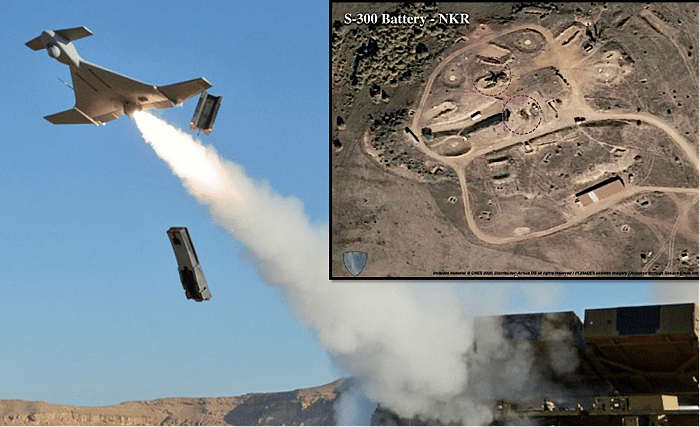
An Armenian S-300 SAM battery near Stepanakert (inset) showing damage from a mass drone strike by Azerbaijan’s Israeli made Harop loitering munition UAVs | sameerjoshi73.medium.com

However, the drone assaults on Khmeimim AFB and Saudi oil facilities, as well as coordinated use of drones in Ukraine, Syria, Libya and Nagorno-Karabakh display early flashes of evolution in future aerial warfare towards the concept of what is known as ‘drone swarming’. In particular, the mass drone attacks on Russian forces in Syria has highlighted the rampant danger that unmanned aircraft in a group increasingly pose, even in the hands of non-state actors. Such small drone teams, collaborating together, offer a game-changing capability for not only larger nations like the United States, Russia, China and Russia, but also small nations and non-state players, who will use the drone swarms in a highly asymmetric role. Very significantly, low cost unsophisticated drones working together and aiming for target saturation through numbers, impose a high cost penalty on the air defence elements.

While defences may be able to fend off a handful of these improvised drones executing a very loosely coordinated attack, a near peer-state competitor can field a much advanced, denser, more nimble, adaptable, and networked force.

Demystifying drone swarming

So what exactly is a drone swarm? Swarm robotics is an approach to the coordination of multiple autonomous robots as a system which consists of a large number of mostly physical robots, controlled by minimal human intervention. These exhibit collective self organising (SO) behaviour through interaction and cohesion between robots, as well as interaction of robots with the environment.

Swarming algorithms are empowered by biological studies of swarm behaviour of insects, fishes, birds and animals. Swarming R&D across the world is focussed on development of distributed artificial swarm intelligence capability, commodification of technology for lesser cost impact and increasing state of autonomy between the agents in a swarm.

While massed drones in spectacular light shows are all controlled centrally, in a true swarm, each of the drones flies itself following onboard AI to maintain formation and avoid collisions with algorithms mimicking nature — there is no true leader and follower, with all agents in a swarm having their own ‘mind’ able to undertake collective decision-making, adaptive formation flying, and self-healing. The benefit of such a swarm is that if one drone drops out — and a few appear to crash — the group can rearrange itself to continue undertaking the mission till the last UAV in air.

Over time as militaries have incorporated greater communications, training, and organisation — they were able to fight in an increasingly sophisticated manner, leveraging more advanced doctrinal forms, with each evolution superior to the previous. Today militaries predominantly conduct manoeuvre warfare. Here swarming would be the next evolution in warfare — with the swarms exhibiting the decentralised nature of melee combat, along with the mobility of manoeuvre warfare. They have varied levels of autonomy and artificial intelligence. The autonomy extends military reach into the well defended battlespace, operating with greater range and persistence than manned systems; while artificial intelligence ensures dangerous and suicidal missions, thus allowing more daring concepts of operation (CONOPs). Both provide greater success in face on increased threat levels and rapid penetration of contested airspace.

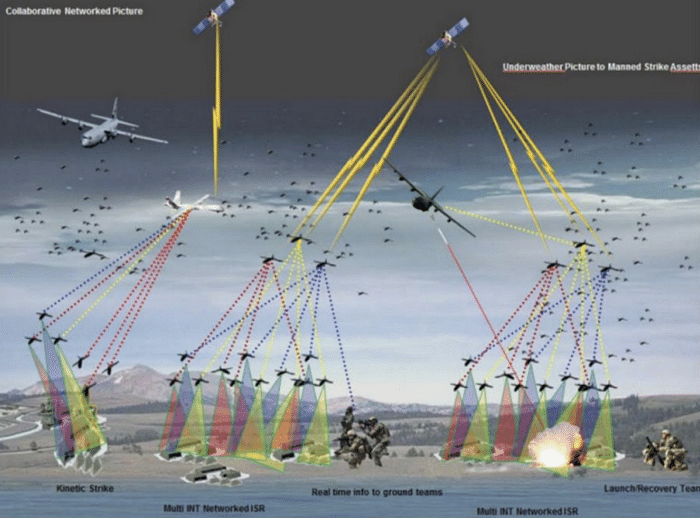
This switch to the unmanned is happening all across the world. And the most preferred route for delivery of a kinetic and non-kinetic payloads is via air. Traditionally, in airpower-heavy militaries like the United States, air operations have relied on increasingly capable multi-function manned aircraft to execute critical combat and non-combat missions over the decades. However, adversarial abilities to detect and engage these aircraft from longer ranges having improved are driving up the costs for vehicle design, operations and replacements. Thus an ability to send large numbers of small unmanned air systems (UASs) with coordinated and distributed capabilities, could provide militaries across the world with improved operational footprints at a much lower cost. These, embedded with manned elements, will effectively saturate adversary targets as a ‘system of systems’. Here Manned & Unmanned Teaming (MUM-T) acts as a force multiplier with autonomy and collaboration and the warfighter’s role transforming to — commanding, rather than controlling a swarm. Once unleashed an armed, fully autonomous drone swarms (AFADS) with distributed AI will locate, identify, and attack targets without human intervention.

The AFADS will prove to be a game changer in the next generation battlefield | sameerjoshi73.medium.com

While new technologies, and in particular AI and edge computing, will drive drone swarms — the key element is still going to be the swarming software. Towards this, all collective behaviour can ideally be clubbed under the term ‘swarm’. However, collaborative autonomy has ‘three’ transformational echelons of behaviour — flocking, where a discernible number of UAVs execute abstract commands autonomously, but fall short of true swarm behaviour. UAVs attacking the Russians AFB in Syria and the Saudi oilfields utilised this echelon. Swarming, where a large numbers of UAVs aggregate entirely through swarming algorithms in real time and is the highest state of collaborative autonomy. Loyal Wingman utilise the collaborative autonomy either through emergent flocking or core swarming behaviour. These platforms will operate in MUM-T mode, flying at high speeds alongside fighter jets and carrying missiles, ISR and EW payloads. The Loyal Wingman will be expected to target ground installations and shoot down enemy aircraft, as well as survive against SAMs and electronic attacks in contested airspace.

Military swarming in the US

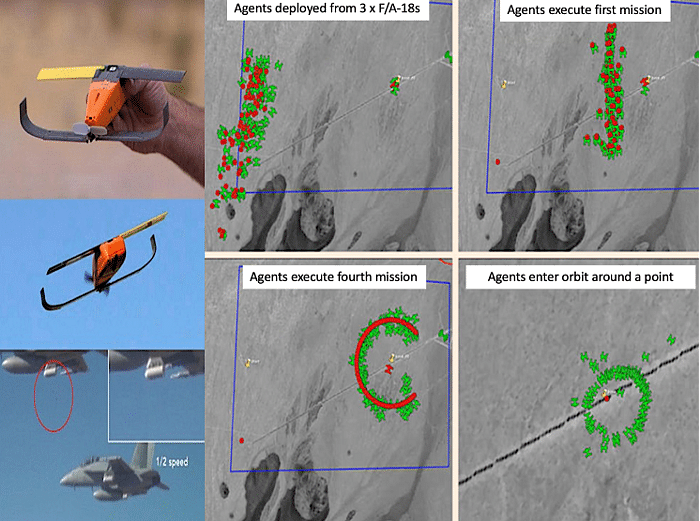
The United States is the world leader in swarm technology and has underway a host of swarming UAV and munition initiatives. It demonstrated the Perdix swarm in 2017. A trio of F/A-18 Super Hornet fighters release a total of 103 Perdix drones in air.

The drones formed up at a preselected point and then headed out to perform four different missions. Three of the missions involved hovering over a target while the fourth mission involved forming a 100-meter-wide circle in the sky. The demo showed Perdix’s collective distributed intelligence, adaptive formation flying, and self-healing abilities.

There are a many uses for such a drone swarm. The drones could be released by fighters to provide reconnaissance for troops on the ground, hunting enemy forces and reporting their location. They could also jam enemy communications, form a wide-area flying communications network, or provide persistent surveillance of a particular area. They could be loaded with small explosive charges and attack individual enemy soldiers. In air-to-air combat, they could spoof enemy radars on aircraft, ground vehicles, and missiles by pretending to be much larger targets.

The Perdix Swarm UAS demo in 2017 is a significant capability demo | sameerjoshi73.medium.com

The US Defense Advanced Research Projects Agency (DARPA) has also showcased the X-61A Gremlin air launched drones. The idea behind DARPA’s Gremlins program is to turn cargo aircraft like the C-130 into motherships capable of launching and retrieving swarms of small drones. This would open up a world of possibilities to the military, allowing deployment of swarms of small, inexpensive, reusable drones with different sensors and payloads from legacy aircraft.

The US Navy and Marine Corps’ Low-Cost UAV Swarming Technology (LOCUST) program, which fires small UAVs from a tube-based launcher to conduct varied class of missions, is another swarm development underway.

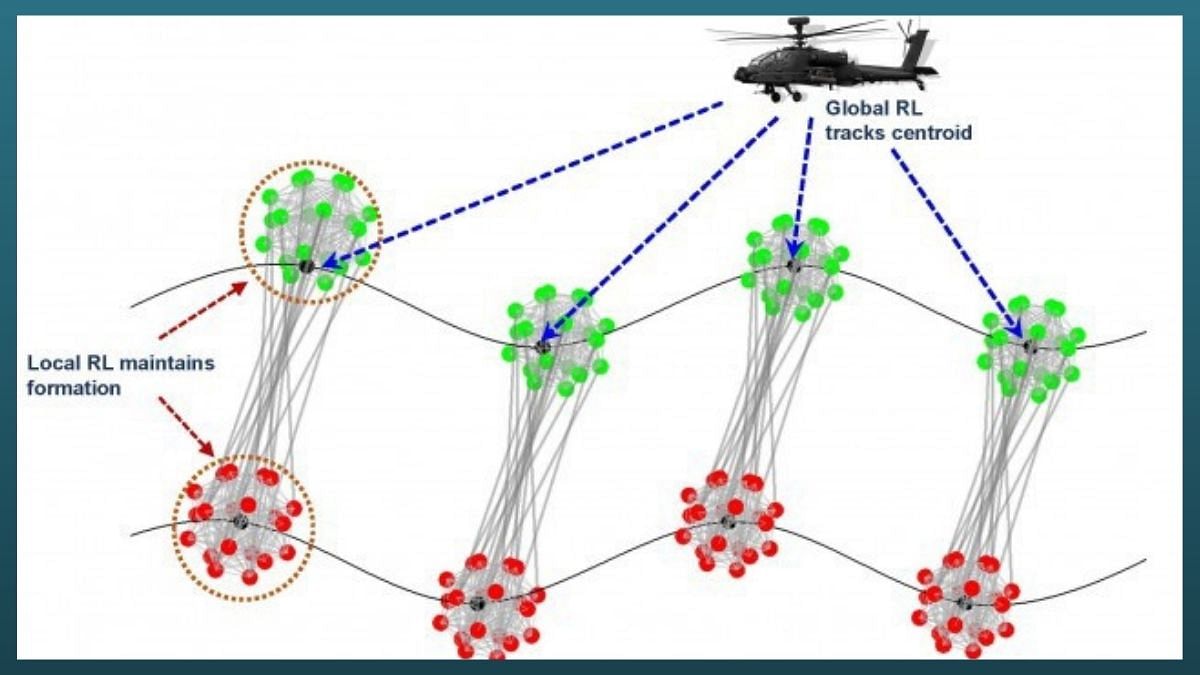
The US Army is also working on drone swarms and Reinforcement Learning (RL)-based AI algorithms for use in tactical battlefield area in multi-domain battle scenario, where swarms will be dynamically coupled and coordinated with heterogeneous mobile platforms to overmatch enemy capabilities.

Employment of Reinforcement Learning Based architecture will enhance the efficiency of swarms | sameerjoshi73.medium.com

The US is also experimenting with collaborative smart munition delivery using the Cluster UAS Smart Munition for Missile Deployment where the payload can be launched and deployed from a GMLRS or ATACMS platform. The payload consists of multiple deployable smart UAVs capable of delivering small explosively formed penetrators (EFP) to designated targets. The USAF’s Golden Horde — part of the Vanguard initiative to develop next generation offensive technologies — will network munitions like Small Diameter Bombs (SDB) together to operate cooperatively after being launched according to a set of predetermined rules and thus increase effectiveness.

Further, the USAF’s ‘Skyborg’ initiative aims to design and deploy an artificially intelligent fleet of loyal wingman unmanned combat air vehicles (UCAV). The Kratos XQ-58A, the Sierra 5GAT and Boeing’s ATS are undergoing development trials as part of Skyborg.

Military swarming across the world

On the other hand, the UK may have the world’s first operational swarm drone unit by the middle of 2021 to perform tasks including suicide missions inside enemy lines and overwhelming adversary air defences. The Royal Air Force’s №216 squadron has been tasked to test and deploy future drone swarm capability. The UK has also announced the Project Mosquito, which is a part of the RAF’s Lightweight Affordable Novel Combat Aircraft (LANCA) unmanned loyal wingman program. This aims to fly a networked unmanned wingman by 2023.

UK has also tested an autonomous swarm of drones each carrying a variant of Leonardo’s BriteCloud expendable active decoy as an electronic warfare payload. Using the BriteClouds, which contain electronic warfare jammers, the drones were able to launch a mock non-kinetic attack on radars acting as surrogates for a notional enemy integrated air defence network

Airbus in France has demonstrated for the first time collaborative remote carrier (RC) swarms and wingman technology towards the Future Combat Air System (FCAS)/Systeme de Combat Arien du Futur (SCAF) program.

The Russians have had an extensive experience operating collaborative drones and countering the same in Ukraine and Syria. The last decade has upscaled UAV efforts in Russia and it aims to induct a large component of robotic vehicles in its military by 2025. It has an initiative called the ‘Flock 93’ which aims to operationalise a high density swam in coordinated saturation strike missions. Originally proposed by the Zhukovsky Air Force Academy and private industry, the concept involves simultaneously launching more than a 100 drones, each armed with a 5.5 pound warhead.

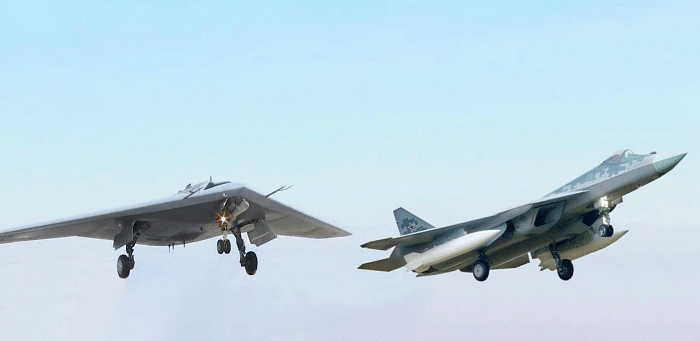
The Russians have also tested the S-70 Okhotnik UCAV in loyal wingman roles with its fighter jet fleet to penetrate adversary airspace. A lighter loyal wingman project with the designation Grom has also been unveiled by Russia in 2020. The Russians are aware of the lead in swarm autonomy which the US and China have, and are engaged in R&D and product development initiatives to close the gap in these niche areas in the coming decade.

Russia’s S-70 Okhotnik loyal wingman with a Su-57 fighter | sameerjoshi73.medium.com

The Chinese are the closest in matching the high density drone swarm capability of the United States and in many ways are replicating the US R&D initiatives with development of AI empowered autonomous drone swarms. Recently The China Academy of Electronics and Information Technology (CAEIT) tested a 48 x tube launched drone swarm of CH-901 UAVs. CAEIT in the past has demonstrated a 200 unit drone military swarm in 2017. Chinese companies have also demonstrated impressive swarms of 1,000 plus drones using quad-copter-type drones for large public displays, which however are ground controlled and do not have distributed intelligence.

The Chinese are undertaking integration of their existing UAV fleet in a robust collaborative autonomy role with the military. It also has a loyal wingman AVIC 601-S ‘Anjian’ under development, which will operate with the fourth and fifth generation PLAAF fighters platforms. Whatever the goals and state of China’s drone swarms developments are, its capability and potential threats are definitely real and rapidly evolving at a fast rate.

Other nations developing swarm technology are Israel, where details on such initiatives are closely guarded. However, given the nature of Israeli operational UAV usage over the years, there are reasons to believe that it matured and has been deployed on its fleet of UAVs and loiter munitions, some of which have been proven by disabling Syrian AD networks.

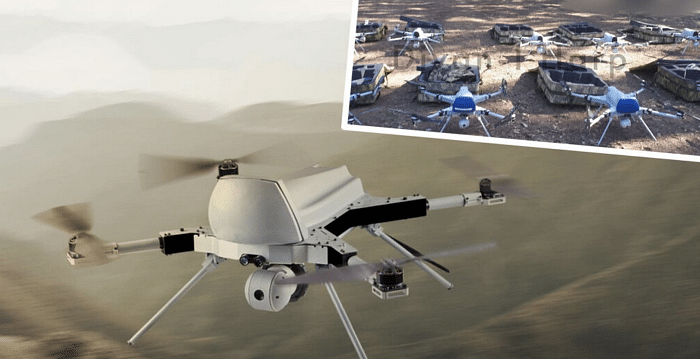
Interestingly, IAI offers a smartphone-based swarming command and control application for worldwide sales. Turkey, which has proven mature MALE UAV capabilities in Syria and Libya through locally made platforms like the TB-2, also has various swarm drone initiatives. Primary amongst them is the Kargu quadcopter which can be employed in kinetic attack roles in the tactical battlefield area. Turkey is vying to be a global UAV power in the days to come. However, the recent US sanctions on its defence industry is likely to curtail high technology induction from the West.

The Turkish Army has deployed 500 plus Kargu swarming drone systems for kinetic attack | sameerjoshi73.medium.com

Iran is another middle eastern nation which has used drones in groups operationally. Iran has embraced unmanned aerial vehicles (UAVs) as a major pillar of its military strategy. Iranian authorities use drones for two main purposes — surveillance and attack, where Iran has the ability to conduct missions over the horizon and in most weather conditions. These include drones with the ability to drop bombs or launch missiles and return to base and ‘kamikaze’ drones that seek targets of opportunity.

Iranian authorities have had more success with the latter as was visible in the Saudi oilfield strikes in 2019, where Iranian made drones and cruise missiles were used. While baseline collaborative autonomy in terms of vehicle flocking may be available, both Iran and Turkey have not shown true distributed intelligence ability amongst their UAV swarms. But their efforts are a clear indication of how the technology is maturing and proliferating.

India’s swarm drone odyssey

In India, the Indian Air Force has been pioneering swarm drone research and development with its Meher Baba initiative since 2019. This is geared towards in depth humanitarian assistance and disaster relief (HADR) operations.

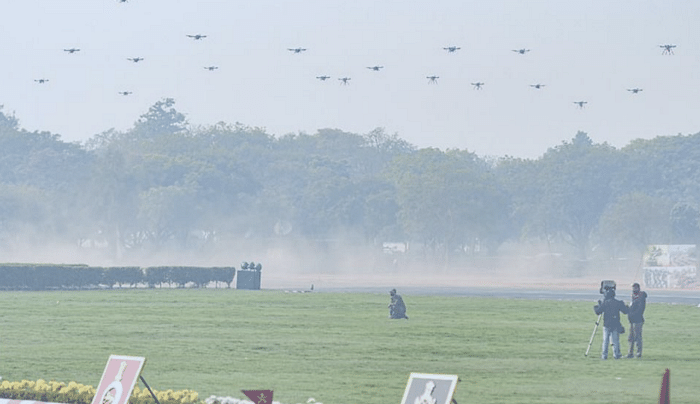
On the other edge of the spectrum, the Indian Army showed off a mature offensive capability with a swarm of 75 autonomous drones with distributed intelligence and edge computing, destroying a variety of simulated targets with kamikaze attacks during India’s Army Day parade in New Delhi in January 2021. In the demo, scout drones investigated the targets, then attack and mothership drones released payloads and explosive-laden kamikaze drones, which carried out the attacks. Western commentators noted several significant features of the Indian Army demonstration comparing it to the United States effort around drones, which often emphasises a large homogenous swarm. It was pointed out that India’s original work, which showcased a heterogenous swarm effort for the first time in the world in public — as the probable way forward in this domain. An Indian Start-up company NewSpace Research & Technologies is associated with the Indian Army on its swarm development program.

Indian Army demonstrated a 75 drone heterogenous swarm on Army Day 2021 in New Delhi | sameerjoshi73.medium.com

The Hindustan Aeronautics Limited (HAL) in India has unveiled the Air Launched Flexible Asset (ALFA -S) air launched swarming drone system as part of it next generation Combat Air Teaming System (CATS). This is a unique program which utilises a network of air launched remote carriers and swarming units to penetrate contested airspace. The USAF’s Air Force Research Labs is collaborating on aspects of the ALFA-S with India. NewSpace Research & Technologies Pvt Ltd is also a partner in the HAL’s ALFA initiative.

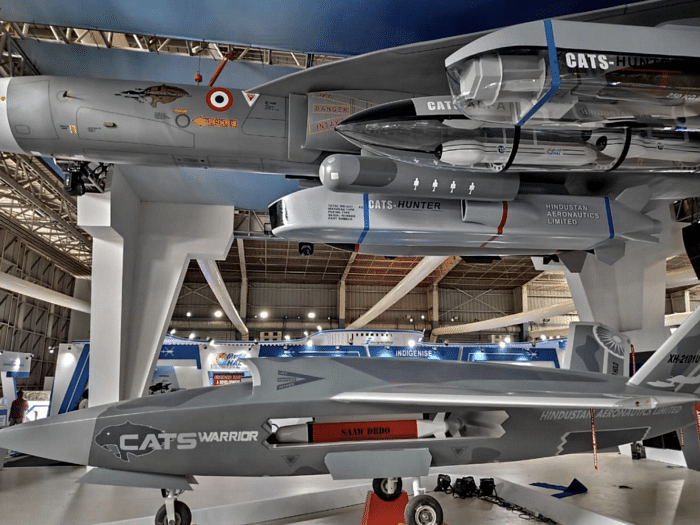
Another component of HAL’s CATS program is the Warrior loyal wingman asset. This is geared for air defence and offensive strike missions and will be employed in a MUM-T role with India’s Tejas LCA and the upcoming AMCA fifth generation combat aircraft. What is noteworthy is that India is well driven by the power of indigenous research and the government’s ‘Make in India’ push to embrace disruptive technologies, which in some areas is at par with similar efforts happening across the world. HAL has unveiled the first 1:1 mock up of the Warrior in AeroIndia 2021 at Bengaluru.

The future is now

It is pertinent to note that while drone swarms may not be ready as an end state ‘product’, proliferation of basic swarming technology is inevitable in the coming decade across the world. Here advances in drone swarming, which is the next evolution of robotic warfare are mostly classified, though governments have given glimpses of their progress over the years. The question is not if, but when and where drone swarms will be utilised as part of a mature concept of operations (ConOps).

HAL’s CATS Warrior Unmanned Wingman has been unveiled at Aero India 2021 | sameerjoshi73.medium.com

Swarming ConOps, a red herring for most nations, can only be matured with clinical and robust field trials utilising hundreds of heterogenous swarming units. It is this ‘scale and associated cost’ borne by the end user which will determine a dynamic adoption, meaningful way ahead towards operationalisation and acceptable timelines of induction towards exploited usage of swarms as true agents of warfare. It is here that countries like the United States and China have a distinct advantage over the rest of the world towards deployment of swarm drone capabilities across the spectrum of missions, at a scale which will tilt the balance in their favour in the digitally contested airspace of tomorrow.

- Credit S. Joshi

Tuesday

NAVIC - India's own GPS


With the launch of the seventh and last satellite of the Indian Regional Navigation Satellite System (IRNSS) on Thursday, India joined a select club of countries with their own global positioning systems.

Thursday

Mission Aditya-1 - After successful mission to Mars India gears up for Sun

When India launches its maiden Aditya-1 Mission, it will further illuminate our understanding of the sun

          Photo: Bruno Caimi
 Photo: Bruno Caimi
Though the sun marks the difference between a habitable world and a barren wasteland, we are only beginning to understand the various dynamics of our parent star. The yellow ball of gas that brightens up our days (and nights) shapes the physical processes on Earth and sustains our foodchain. Earth’s climate is governed by the sun and the sun’s variability is a hotly debated issue in climate science. For instance, the Little Ice Age of 1816 was the result of a mere one degree fall in global temperatures. “1816 came to be known as the year without summer. Crops failed to grow. In Ireland, a famine and a subsequent typhoid epidemic killed 65,000 people,” says Bill Bryson in A Short History of Nearly Everything.

More than 20 international space missions are trying to understand sun’s structure and composition. Now India is gearing up to launch its maiden mission, Aditya-1, which will be launched in 2019-2020. More than 50 solar scientists from 10 institutions across the country are working round the clock to shield us from the impacts of unruly space weather and sun’s variability on Earth’s climate. When Aditya-1 is launched, India will join a select group, which includes USA, Japan and the European Space Agency, that have sent missions to the sun.
* NASA: National Aeronautics and Space Administration;
JAXA: Japan Aerospace Exploration Agency; ESA:
European Space Agency
* NASA: National Aeronautics and Space Administration; JAXA: Japan Aerospace Exploration Agency; ESA: European Space Agency
What Aditya-1 will study

“Our primary objective is to study the solar corona, processes leading to changes in it, and to understand what heats the corona. Observations of sun’s photosphere, chromosphere and corona are also possible,” says Deviprasad Karnik of the Indian Space Research Organisation (ISRO), which is leading the mission.

The corona is the outermost layer of the sun’s atmosphere, preceded by the chromosphere and photosphere respectively. “The mission will provide a multipronged holistic approach to understanding some of the outstanding problems of solar physics,” says Karnik (see ‘Sun surfing’).

“We are in the process of designing the payloads. Aditya-1 will be launched from Sriharikota, an island off Sullurupeta, a sm-all town in Nellore district, Andhra Pradesh,” Karnik says.

The other institutes working on Aditya-1 include the Indian Institute of Astrophysics, Bengaluru, which is working on the Visible Emission Line Coronagraph (see interview), the Physical Research Laboratory, Ahmedabad, which is working on the Aditya Solar Wind Particle Experiment and the Vikram Sarabhai Space Centre, Thiruvananthapuram, which is working on Plasma Analyser Package for Aditya.

When the mission was first conceptualised in 2008, its launch was envisioned to coincide with solar maxima—a period of intense sun activity that occurs every 11 years. However, it was later decided that the satellite would be placed in a halo orbit around lagrangian point 1, which is 1.5 million km from Earth (where a satellite can maintain its position with respect to other bodies). “The initial concept was to put the coronagraph payload in a small satellite in an 800 km low Earth orbit. Aditya-1 is an updated version of the original Aditya mission with six additional payloads,” adds Karnik.

The advantages of placing the satellite in a halo orbit are many. Situated outside Earth’s atmosphere and magnetosphere, it remains unaffected by Earth. A halo orbit also ensures that there is no occultation for the spacecraft’s line of sight. Moreover, a satellite placed in a halo orbit experiences much less mechanical and thermal disturbances, and is, therefore, more stable.

What past missions have found

Other sun missions have added gravity to our understanding of the sun. The Solar and Heliospheric Observatory (SOHO), a collaboration between the European Space Agency and the National Aeronautics and Space Administration (NASA), celebrated its 20th anniversary on December 2, 2015. “SOHO changed our popular view of the sun from a picture of a static, unchanging object in the sky to the dynamic beast it is. It showed us what we had never seen before. We realised we need more eyes on the sun,” says Bernhard Fleck, a project scientist with SOHO.

This gave birth to a plethora of space-based solar observatories: Hinode, the Solar Dynamics Observatory (SDO), the Interface Region Imaging Spectrograph and the Solar and Terrestrial Relations Observatory. NASA’s SDO has been recording the sun’s dynamic solar activity since its launch on November 2, 2011 (see ‘Light alight’).

“The scientific objective of the SDO mission was to understand the lifecycle of the solar magnetic field. We wanted to understand how the sun’s magnetic field is generated, how it moves around the sun, and how it is destroyed. With this understanding, we sought to develop the science needed to predict solar activity,” says Dean Pesnell, a project scientist with SDO.


ASPEX: Will study the variation, distribution and spectral characterstic of solar wind
WHY: Solar wind can affect our power lines, communication satellites and high altitude spacecraft

VELC: Will study the parameters of the solar corona and origin of Coronal Mass Ejections (CMEs)
WHY: CMEs can collide with Earth's magnetic field and change its shape

SUIT: Will image the photosphere and chromosphere in UV range
WHY: A better understanding can help us keep track solar flares emanating from the photosphere

SoLEXS: Will monitor X-ray flares to study the heating mechanism of the corona
WHY: Energy from X-ray flare can disrupt radio waves, causing blackouts in navigation and communications signals

PAPA: Will study the composition of solar wind and its energy distribution
WHY: Solar wind can disrupt communication and navigation satellites

HEL1OS: Will observe the dymanic events in the corona and estimate the energy used to accelerate the particles during the eruptive events
WHY: An estimate of the energy can help us shield ourselves in an effective and timely manner
Predicting solar activity assumes immense significance. On the night of September 2, 1859, the world woke up to red, green and purple auroras that had erupted nearly everywhere on Earth and not just at the poles where they are a characteristic feature. Telegraph systems were disrupted as the world witnessed its first recorded solar flare, also known as the solar storm of 1859. And as recently as on July 23, 2012, a solar storm, touted to be as strong as the one in 1859, was predicted. Fortunately, we missed it by a week—Earth had moved ahead in its orbit.

Disruptions in the solar atmosphere and surface can also cause a flurry of solar activity that affects space weather. A better understanding of the sun can also help in aeronautics (high-altitude aircraft exposure to radiation), astronautics (radiation threat to astronauts and spacecrafts) and technology infrastructure development (effects of radiation on communication satellites).

As new frontiers in scientific enquiry are being conquered, they are only throwing up more questions. “The next frontier in our understanding of the sun is to measure its polar regions with the same instrumentation we use near the equator. At present, we have very few measurements from above the poles,” says Pesnell. “Better predictions will lead to a more cost-effective response. Power plants that will be affected can be isolated; satellites can be tuned to power off sensitive high-voltage components, and, astronauts in deep space can get into a safe shelter before the danger arrives,” adds Pesnell.

Aditya-1 will hopefully reveal, among other things, why the solar corona heats up to temperatures of a million degrees or so, much higher than the visible outer layer of the sun’s surface—the photosphere. Findings that will unlock the secrets to our understanding of our parent star.
`Aditya-1 will take images every second'
 
Dipankar Banerjee of the Indian Institute of Astrophysics (IIA), Bengaluru, which is one of the institutions working on Mission Aditya-1, speaks to Down To Earth

What specific area of the mission is the IIA working on? 

IIA is making the Visible Emission Line Coronagraph (VELC), which is one of the main payloads. Coronagraph creates an artificial total solar eclipse in space by blocking the sunlight by an occultor. This telescope will have capabilities of spectral imaging of the corona in visible and infra-red. We are in phase 1 of the mission. Design and review are almost complete.

What is going to be the payload capacity of the mission?

The coronagraph is the biggest payload occupying 60 per cent of weight of the instruments on board Aditya-1. Using this payload, we want to study the dynamic changes in the sun.

How is Aditya-1 different from previous missions to the sun?

Aditya-1 is a multi-wavelength observatory which will look at different layers of the solar atmosphere. Aditya-1 is different in many ways. Take NASA's STEREO. It has two coronagraphs and one imager. The coronagraphs on board STEREO take images every 10 minutes, and probes only at the outer corona. Aditya-1's VELC, on the other hand, will look at the inner corona and will take images every second.

Tuesday

Eyes in the sky

Indian Space Research Organisation (ISRO) is all set to launch a new earth observatory named CartoSat-2C in May. The satellite built for military purposes will blast off using the renowned PSLV (Polar Satellite Launch Vehicle). After the launch, India will join the ranks of China and USA who have their own spy satellites to monitor activities on Earth from space.
Indian space scientists built the satellite at the Space Applications Centre  (SAC) in Ahmedabad. Several rounds of tests were performed to check the durability and functioning of the satellite. Two weeks ago, CartoSat-2C was shifted to ISRO Satellite Centre (ISAC) at Bengaluru. India’s first dedicated military satellite — CartoSat-2A was launched in 2007 and since then it has given very sensitive and highly classified information including the missile launches in the neighbourhood.
According to the official report, the satellite weighs 690 kilogram. The high-resolution multi-spectral instrument and Panchromatic Camera will enable the satellite to capture some stunning high-resolution images. Previous military satellite had the resolution of 0.8 metre while the new camera installed on the CartoSat-2C has a resolution of 0.65 which means that it can spot even smaller objects from space. What’s striking about the camera of the new satellite is that it has the capability to record videos, process it to reduce size of the file and then beam it back to the Earth.
CartoSat-2C will blast off along with 21 other satellites using PSLV rocket in May this year. It will be placed in a sun-synchronous polar orbit at a low-earth altitude of about 200-1,200 kms above the Earth’s surface. Once launched, it will be one of the finest eyes present in space.
ISRO officials describe this satellite “as one of the best eyes in space” that India has launched till date. The strength of the camera installed in this home-grown satellite is almost at par with the ones possessed by US and China. For instance, in 2014, the Chinese had set a remote sensing satellite “Yaogan 24” which had a similar camera of 0.65 metre resolution. The panchromatic imagers can not only be used for surveillance, but can also aid in disaster monitoring. It will also click images that can give an idea of temperatures of a particular location in comparison with the surrounding areas. Cartosat-2C is expected to be launched along with 21 other satellites in May using a PSLV rocket. It will be placed in a sun-synchronous polar orbit at a low-earth altitude of about 200-1,200 kms above the Earth’s surface. - See more at: http://indianexpress.com/article/cities/ahmedabad/cartosat-2c-to-boost-military-surveillance-capabilities/#sthash.IugXyw6r.dpuf

Indian Nuclear Submarine fully operational with 3500 Km range SLBM

India has secretly conducted the maiden test of its nuclear capable undersea ballistic missile, code named K-4, from homegrown submarine INS Arihant at an undisclosed location in the Bay of Bengal.
The test conducted on March 31 nearly 45 nautical miles away from Vishakhapatnam coast in Andhra Pradesh was highly successful. The indigenously developed weapon with a dummy payload was reportedly launched from the submarine in full operational configuration. 

KILLER K-4

Intermediate Range SLBM
Operational Range – 3,500 km
Length – 12 meter
Width – 1.3 meter
Weight – 17 tonne
Warhead – 2,000 kg
Engine – Solid fueled
Accuracy – Near zero CEP
The trial was carried out with the support of the personnel of Strategic Forces Command (SFC) while the DRDO provided all logistics. The missile was fired from 20-meter deep and it pierced into the sky after breaking the water surface. INS Arihant had first successfully fired a prototype of K-15 (B-05) missile in November last year.
The K-4 missile was fired from onboard silos of the ship submersible ballistic, nuclear (SSBN) submarine demonstrating the capability of the newly built underwater warship to fire long range nuclear capable missiles and the killing efficiency of the most advanced state-of-the-art weapon system.
“Having an operational range of nearly 3,500 km, the missile was fired towards north for a shorter range. It covered more than 700 km before zeroing on the target with high accuracy reaching close to zero circular error probability (CEP),” informed the source.
On March 7, this missile was test fired from a submerged pontoon (replica of a submarine) positioned nearly 30 feet deep sea offshore Vizag coast. Although, the DRDO didn’t officially confirm about the secret mission, it was learnt that the test was a roaring success.
Even as the DRDO had reportedly conducted the first test of the missile system, which was developed under a secret project, in 2010, it officially admitted to have a missile named K-4 with a video footage of the missile launch in the Aero-India show in January last year.
Reports indicated the K-4 missile with the features of boost-glide flight profiles is designed to defeat any anti-ballistic missile systems. Equipped with the satellite updates to modify accumulated errors from its inertial navigation system, the weapon system is claimed to be quite dangerous and one of its kind in the world.
The 111-metre-long INS Arihant has four vertical launch tubes, which are capable of carrying 6 torpedoes of 533 mm and 12 B-05 (K-15) missiles or 4 K-4 missiles.
Powered by an 85 MW capacity nuclear reactor with enriched uranium fuel, this submarine can achieve surface speeds of 12 knots to 15 knots, and submerged speeds of up to 24 knots, carrying a crew of 95.
Apart from Arihant, the K-4 will also arm another Arihant class submarine INS Aridhaman which is currently under construction along with two others. These submarines will have eight launch tubes each.
India’s Defense Research and Development Organization (DRDO) has once again test-fired the K-4 nuclear-capable submarine-launched ballistic missile (SLBM)–this time from aboard the Indian Navy’s indigenously built nuclear submarine, the INS Arihant, the first submarine in its class.  In March 2016, DRDO had successfully tested the K-4 from a submerged platform in the Bay of Bengal.
According to the New Indian Express, the Arihant-based K-4 test was “conducted on March 31 nearly 45 nautical miles away from Vishakhapatnam coast in Andhra Pradesh.” The K-4 missile was fired from theArihant‘s onboard SLBM silos.
India’s K-4 is an intermediate-range, nuclear-capable, submarine-launched ballistic missile. Though official details remain scarce given the project’s sensitivity, most estimates place the K-4′s range at roughly 3,500 kilometers. Recent testing of the K-4 has sought to test the full operational range of the missile. The DRDO scientists’ purported aim this week is to test the full operational range of the missile. During a previous test in March 2014, where the weapon was ejected from the submerged pontoon by a powerful gas generator, the K-4 was only tested to a range of 3,000 kilometers (1,864 miles). In addition to its range, recent testing as sought to test the SLBM’s accuracy. Claims by DRDO scientists and publicly available information on the system suggest that the K-4 is a highly accurate system. As Franz has discussed, DRDO scientists have boasted that the K-4 has “near zero circular error probability” and uses “a Ringer Laser Gyro Inertial navigation system.”
The K-4, along with the K-15 Sagarika SLBM, will give the Arihant-class of nuclear submarines their nuclear strike capabilities, allowing India to field an undersea nuclear deterrent capability. The K-15 has a considerably shorter range than  the K-4. At a maximum strike range of approximately 750 kilometers, Arihant-class submarines would have to move close to enemy shores to successfully deploy the K-15 SLBMs, increasing the odds of detection. The intermediate-range K-4 helps rectify this shortcoming. The K-4 is capable of carrying both conventional and nuclear payloads in excess of 2,000 kilograms.
The Indian Navy anticipates commissioning the first Arihant-class submarine in 2016. The Indian Navy anticipates eventually fielding a force of three to six Arihant-class submarines. INS Aridhaman, in construction, will be the second submarine of the Arihant-class. Each submarine will be able to carry 12 K-5 Sagarika missiles and 4 K-4 SLBMs. With the Arihant‘s commissioning, the Indian Navy will join the navies of the United States, the United Kingdom, France, Russia, and China in operating nuclear-powered ballistic missile submarines.

Wednesday

INS Arihant - India's nuclear submarine inducted

Arihant has completed all tests including deep dive and weapon firing tests past five months in secrecy. Two more such SSBNs with bigger payloads, more advanced features and size are already under construction with two more planned for a total of five. India does not have a submarine rescue vehicle hence Russian Prut class vessel Epron accompanied Arihant for the deep dive tests. Arihant submarine can carry K4 missiles equipped with nuclear weapons, MIRV possibility, with a range of 3500 KM. This manoeuvrable missile having an innovative system of interlacing in three dimensions can also cruise at hypersonic speed. This exceptional feature of the weapon system makes it difficult to be tracked easily and destroyed by any anti-ballistic missile defence systems. The missile has a high accuracy of near-zero circular error probable. India has so far planned three missiles in the K-series. While the 700-km range K-15, renamed as B-05 (launched 10 times) and 3,500-km range K-4 have been developed, the K-5 will have a striking capability of over 5,000 km. All the K-series missiles are faster, lighter and stealthier. India currently operates one nuclear submarine INS Chakra, Akula class SSN leased from Russia.